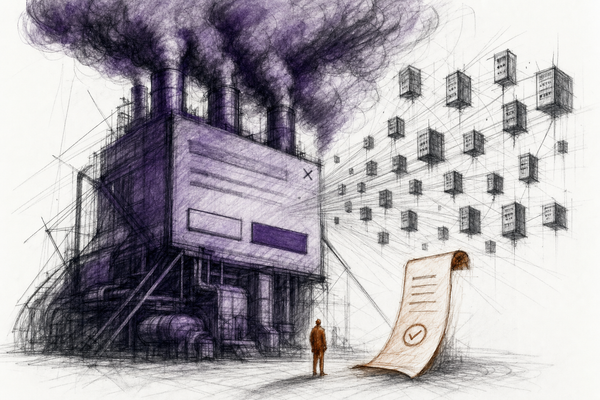
Digital Public Transparency Infrastructure (DPTI)
Digital Public Transparency Infrastructure (DPTI) is the public, interoperable layer that makes controller accountability inspectable before any personal data is collected or any identification is demanded.


It is not “privacy infrastructure.” It is transparency infrastructure that provides the standard safety, and security for privacy-enabling control: an individual can verify who is accountable and what is being claimed, then choose whether to proceed.
What Digital Public Transparency Infrastructure (DPTI) is
Digital Public Transparency Infrastructure (DPTI) is a public, verifiable layer for digital accountability.
It turns “terms we hope you read” into machine-readable disclosures that can be checked, archived, compared over time, and used as evidence.
DPTI has a simple ordering constraint:
- The controller’s accountability must be inspectable before any identification is demanded.
- The conditions of the relationship must be inspectable before data collection begins.
Why DPTI exists: move from black-box trust to glass-box governance
Most digital systems still operate as black boxes. They ask for permissions or personal data first, while controller identity, purposes, sharing, and legal justification remain unclear, buried in links, or presented after the fact.
A glass-box governance model flips the order. Transparency becomes the control surface:
- If a relationship is surveillance-capable, the relationship must be inspectable.
- If the relationship changes, the change must be recorded.
- If authority is claimed, the authority must be checkable.
DPTI exists to make these requirements operational at scale.
/
The 0PN Policy Group: curating DPTI components by consensus
The 0PN Policy Group is a curation and governance surface for DPTI.
The job is not to produce more prose. The job is to curate the reusable components that make transparency durable, interoperable, and enforceable.
We use a consensus protocol because:
- DPTI components have to be safe to reuse across sandboxes, jurisdictions, and implementations.
- Category errors are dangerous (for example, treating a “consent record” as a surveillance record).
- A public infrastructure layer needs stability, provenance, and a traceable trail for why something is “current.”
Consensus (here) is not simply agreement in a call. Consensus is an authoritative position with a checkable trail.
DPTI focus area: digital public notice requirements
A core DPTI deliverable is the ability to satisfy digital public notice requirements in a way that is:
- Inspectable before identification
- Evidence-grade (durable, time-bound, and re-locatable)
- Interoperable (usable across services and jurisdictions)
Practically, this means shifting notice from a document into an operational interface:
- Controller identification, disclosed first
- Purpose and justification, stated precisely
- Rights and access points, present and workable
- Versioning and change detection, explicit
The operational vocabulary: making notice usable by systems and humans
To make notice operational, the ecosystem needs an operational vocabulary: machine-readable terms that can be used consistently to express notice conditions, constraints, and governance state.
This vocabulary layer makes it possible to:
- Compare disclosures across controllers
- Detect material changes over time
- Route disputes, audits, and enforcement actions using shared semantics
- Prevent “compliance theatre,” where words exist but cannot be tested
They are required for: Role-based containment and execution-time governance
Glass-box state transitions (what changed, when, and why)
Evidence-grade receipts and tokens that encode meaningful choice
What gets curated (and why it matters)
The Policy Group curates the components a controller must be able to publish and maintain as a stable public interface. Examples include:
- Controller identification artefacts (who is accountable)
- Digital notice artefacts (what is disclosed, for which purposes)
- Change-logging artefacts (how governance state changes are recorded)
- Vocabulary and mapping artefacts (how terms are used without category errors)
The goal is that any individual can inspect what is being claimed, verify it, and make a meaningful choice.
Closing: transparency first is the prerequisite
A system cannot credibly claim valid authority, fair terms, or meaningful choice unless the individual can inspect the conditions first.
That is what Digital Public Transparency Infrastructure provides: a transparency-first public layer that makes governance checkable by default.
- 0PN Lab Policy Group — building digital public transparency infrastructure that enables privacy-enabling control.
- Bi-weekly — Tuesdays, 11:00 AM ET / 4:00 PM UTC