
0PN Resources
0PN DPTI (Digital Public Transparency Infrastructure)
Safety, Security and Privacy Transformation Infrastructure
Must Be Digitally Open, Internationally Accessible, and free to access
OPN - DPTI Profile for ISO/IEC 27560:2023 Consent Record Information Structure

Core DPTI (Glass-boxed Governance) Standards
- Convention 108+ Full Text — Legal foundation for transparency obligations across 55+ jurisdictions
- ISO/IEC 29100 Privacy Framework — Transparency as first principle (open and free to download)
- ISO/IEC 27560 Free Access Statement — Universal Notice Receipt Profile (UNRP)
- W3C Data Privacy Vocabulary (DPV) — Machine-readable legal semantics
For Reporting: Conformance and testing
- Kantara ANCR & TPI — Conformance and compliance reporting methodology
Transparency by Default at internet scale
The Digital Public Transparency Infrastructure is a package of international standard, open, and free to access international instruments. Combining established international standards into a cohesive, interoperable framework that makes transparency operationally viable for controllers and enforceable for regulators.
All components are fit for international purpose, open, and free to access for implementation as DPTI.
The Digital Public Transparency Governance Infrastructure - Glass Box Knowledge Model
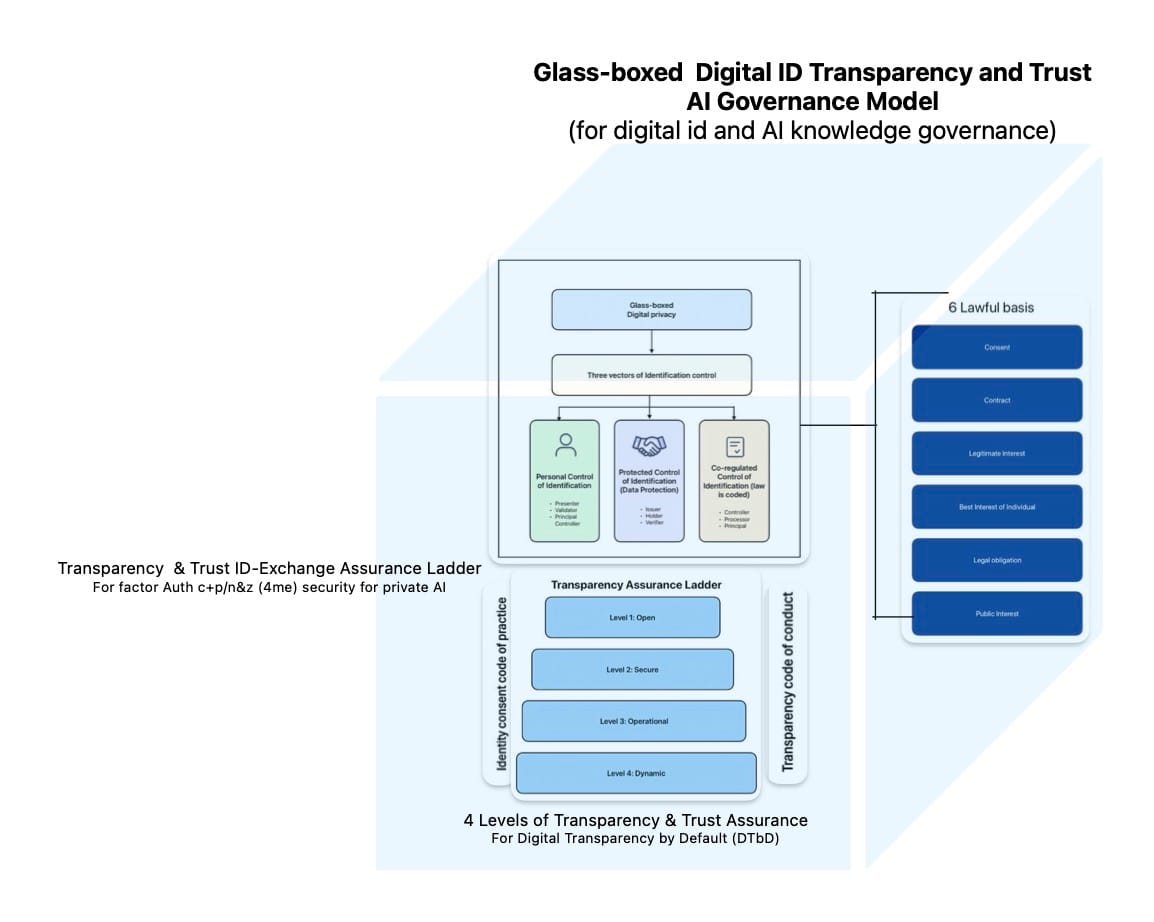
Core DPTI Standards
Convention 108+
Modernized Data Protection Convention of the Council of Europe
Convention 108+ provides the legal foundation for transparency obligations across 55+ jurisdictions.
Key Articles:
- Article 8.2 — Information to be provided to the data subject
- Article 11 — Codes of conduct implementation framework
- Article 5 — Six legal bases for lawful processing
DPTI Implementation: Convention 108+ Transparency Code of Conduct (launching January 28, 2026)
Access: Convention 108+ Full Text
ISO/IEC 29100 Privacy Framework
Transparency as First Principle
ISO/IEC 29100 establishes Transparency as the foundational privacy principle, adopted from the Consent Receipt specification.
Framework Components:
- Privacy principles and terminology
- Transparency as baseline requirement
- Role-based privacy controls
- Privacy safeguards reference architecture
DPTI Implementation: Transparency by Default (TbD) architecture — controllers disclose identity and processing purpose BEFORE collecting personal data.
Access: Open and Free to Download
ISO/IEC 27560 Consent Record Information Structure
Universal Notice Receipt Profile (UNRP)
ISO/IEC 27560-1 defines the record information structure that makes Convention 108+ Article 8.2 machine-readable and operationally enforceable.
Core Specifications in the 0PN Lab:
Controller Identification Record (CIR)
- Served at
/.well-known/notice.txt - Machine-readable controller identity and contact
- Processing purpose and legal basis declaration
- W3C DPV semantic encoding
Universal Notice Receipt (UNR)
- Bilateral proof-of-notice exchange
- Timestamped and cryptographically signed
- Portable across services and jurisdictions
- Legal basis encoding (all 6 Convention 108+ Article 5 bases)
Notice Event Log
- Append-only record of notice and authorization state changes
- Auditable transparency timeline
- Tamper-evident cryptographic integrity
DPTI Implementation: ISO/IEC 27560 Universal Notice Receipt Profile for implementing Convention 108+ online
Access: Available through national standards bodies; 0PN Lab implementation guides free for all members
W3C Data Privacy Vocabulary (DPV) Convention 108+ Legal Model
Machine-Readable Legal Semantics
W3C DPV provides standardized, machine-readable vocabulary for expressing privacy and data protection concepts in Controller Identification Records and Notice Receipts.
Integration with DPTI:
- Purpose taxonomy for CIR disclosure
- Legal basis representation (mapped to Convention 108+ Article 5)
- Processing category classification
- Data subject rights expression
- Cross-border data flow declarations
DPTI Implementation: DPV encoding in CIR and UNR for semantic interoperability
Access: W3C DPV Specification — Free and open
Kantara ANCR & TPI Conformance and Compliance Report
Transparency Performance Indicators — Regulatory (TPI-R)
Kantara Initiative ANCR (Anchored Notice and Consent Record) and TPI provide conformance assessment and compliance reporting methodology for transparency infrastructure at scale.
TPI-R Methodology:
- Baseline transparency scoring across services
- Compliance gap analysis (e.g., Chrome/IAB case studies)
- Regulatory capacity metrics
- Automated auditing across thousands of controllers
DPTI Implementation: TPI-R for regulatory reporting; ANCR for high-assurance transparency
Access: Kantara Initiative — Open specifications; 0PN Lab TPI-R tools for members
Extensibility: Standards Integration
The DPTI Stack is designed for extensibility with complementary standards and protocols
W3C Verifiable Credentials (VC) & Decentralized Identifiers (DID)
Portable, Cryptographically Verifiable Transparency Records
W3C VC and DID standards enable portable, self-sovereign transparency infrastructure:
Integration with DPTI:
- Verifiable Credentials — Issue Notice Receipts as VCs for portability across services and jurisdictions
- Decentralized Identifiers — Controller and individual identity without centralized registries
- Selective Disclosure — Privacy-preserving presentation of Notice Receipts
- Cryptographic Proof — Tamper-evident audit trails
Use Cases:
- Cross-border Notice Receipt portability
- Decentralized Controller Registry alternatives
- Age assurance integration
- AI governance and role-based containment
Access:
- W3C Verifiable Credentials — Free and open
- W3C Decentralized Identifiers — Free and open
Implementation Status: Extensibility layer under development by 0PN Lab Working Groups
AuthC Protocol (Authority with Consent & Permission)
0PN Lab Working Group Initiative
The AuthC Protocol is an open protocol under development by the 0PN Lab Protocol Working Group to extend DPTI with active state signaling and real-time transparency control.
Protocol Design:
- Authority with Consent — Bilateral authorization with real-time revocation
- Active State Signaling — Controllers signal current processing state in real-time
- Permission Management — Granular, purpose-bound data access control
- Cross-Service Portability — Notice Receipts and authorizations work across controllers
Integration with DPTI:
- Level 4 TATA implementation (Active State High Assurance)
- Real-time regulatory auditing
- Dynamic consent and authorization
- Privacy-enabling identity infrastructure
Development Status: Open standards development in 0PN Lab Protocol Working Group
Access: Join the Protocol Working Group to participate in AuthC development
- Free Observer Access — Newsletter and meeting recordings
- Active Participation — £150/year (founder rate) for voting membership
DPTI Stack Implementation Pathways
Level 1: Self-Assertion (Open Notice Practice)
Free — No registration, certification, or fees required (starting Feb)
Standards:
- Convention 108+ Article 8.2 compliance
- ISO/IEC 27560-1 CIR and UNR
- W3C DPV encoding
- IETF RFC 8615 (/.well-known/)
What you implement:
/.well-known/notice.txtController Identification Record- Notice Event Log
- Universal Notice Receipts
View Level 1 implementation guide →
Level 2 -4 (Coming Soon)
Why the DPTI Stack is Different
Open and Free to Access
No proprietary lock-in, no licensing fees
Every component of the DPTI Stack is based on open international standards:
- Convention 108+ — International treaty
- ISO/IEC standards — Available through national standards bodies
- W3C specifications — Free and open
- Kantara Initiative — Open specifications
- 0PN Lab protocols — Open development, free to implement
Fit for International Purpose
Designed for cross-border interoperability
The DPTI Stack is built for Convention 108+ jurisdictions (55+ countries) and compatible with:
- UK GDPR
- EU GDPR
- APEC CBPR
- Canadian PIPEDA
- Australian Privacy Act
Semantic interoperability via W3C DPV ensures machine-readable compliance across regulatory regimes.
Scaling Regulatory Capacity
From thousands of bespoke policies to automated compliance
Traditional privacy policy enforcement requires manual review of thousands of documents. The DPTI Stack enables:
Automated Discovery:
- CIRs at
/.well-known/notice.txtare machine-discoverable - No prior registration required
- Crawlable by regulatory tools
Automated Auditing:
- Machine-readable W3C DPV encoding
- TPI-R compliance scoring
- Notice Event Logs provide tamper-evident trails
Example: TPI-R methodology assessed Chrome and IAB transparency compliance across thousands of services — impossible with manual policy review.
Get Started with the DPTI Stack
Free Access
Newsletter, observer access, and Level 1 tutorials
- Convention 108+ Code of Conduct implementation guidance
- ISO/IEC 27560-1 CIR and UNR templates
- W3C DPV encoding examples
- CLI tools for validation
Standards Community
The DPTI Stack is built in collaboration with leading standards bodies:
- Council of Europe — Convention 108+ legal foundation
- ISO/IEC JTC 1/SC 27 — Privacy and security standards
- W3C — Data Privacy Vocabulary, Verifiable Credentials, DIDs
- IETF — Well-known URI infrastructure (RFC 8615)
- Kantara Initiative — ANCR and TPI conformance
- UN/CEFACT — Cross-border transparency and supply chain integration
- Standards Council of Canada — National standards coordination
- IEEE Digital Privacy — Technical implementation research
- MyData — Individual-centric transparency and control
It's not fair or trustworthy, if it's not Transparent First.
Open standards. International interoperability. Regulatory capacity at scale.